PRODUCT CONCEPT: ItinerAI
DURATION: 1 Week
Completed in May 2026
ABOUT
ItinerAI is an AI-powered travel planning app that removes the stress of building a trip from scratch. Users describe where they want to go, and the app generates a personalized day-by-day itinerary based on their destination, budget, travel style, and group. The plan stays flexible and travels with them.
DESING BRIEF
The goal was to find the right balance between automation and control. Most planning tools either do too much and feel generic, or do too little and leave the work to the user. The design challenge was to make AI feel like a collaborator, not a black box, while keeping the experience fast and low-friction.
MY ROLE
I led the end-to-end product design for this concept, covering research, competitive analysis, user flow mapping, design decisions, and high-fidelity screens. The work spans the full planning experience from first prompt to on-the-ground travel.
SUMMARY
This is an independent product concept I designed to explore how AI can make travel planning feel personal without adding complexity. The focus was on product thinking as much as visual design: every screen decision is grounded in research, competitive gaps, and clear design tradeoffs.
EASY ACCESS
01
MARKET DISCOVERY
MAPPING THE TRAVELER’S JOURNEY
Travel planning is not a single decision. It moves through phases, from dreaming to booking to navigating a city on the ground. Understanding how people actually plan, and where that process breaks down, shaped every product decision that followed.
INSIGHT #1
Planning is not a single moment, it’s a journey with phases.
“Online interactions are increasingly shaping how people make a plan for their next trip. Research shows that travel micro-moments span across dreaming, planning, booking and exploring phases, and even a booked itinerary doesn’t end the research process. Travelers continue looking for things to do while already at the destination.”
Source: How Mobile Influences Travel Decision Making
INSIGHT #2
Most activity decisions happen on the ground, not in advance.
“85% of leisure travelers decide on activities only after having arrived at the destination. Nearly nine out of 10 travelers expect their travel provider to share relevant information while they are on their trip.“
Source: Mobile Travel Research Trends
INSIGHT #3
Travelers need confidence before committing to a plan.
“More than 3 in 5 travelers in each surveyed market said they need to feel a strong sense of confidence that they’ve made the best decision before they book. More than half of all respondents used other sources to cross-check travel information to ensure accuracy.“
Source: APAC Traveler Behavior Research
INSIGHT #4
Busy Millennials as Early Adopters
“58% of US millennials have used AI for trip planning, compared to 45% of Gen Z and just 11% of baby boomers. It’s not the youngest travelers driving this trend, it’s the busiest. For millennials, AI is less about novelty and more about efficiency.“
Source: Travel Forward: Data, Insights and Trends for 2026
INSIGHT #5
Preserving Established UI Paradigms
“Search, filters, and navigation are well-established patterns that users are efficient with after years of practice. A chatbot that repackages product browsing into a conversational interface isn’t solving a problem, it’s adding friction to one that’s already been solved. Chatbots earn users’ trust by highlighting information or reasoning that the rest of the UI doesn’t provide.“
Source: What Is Your Site’s AI Chatbot For?
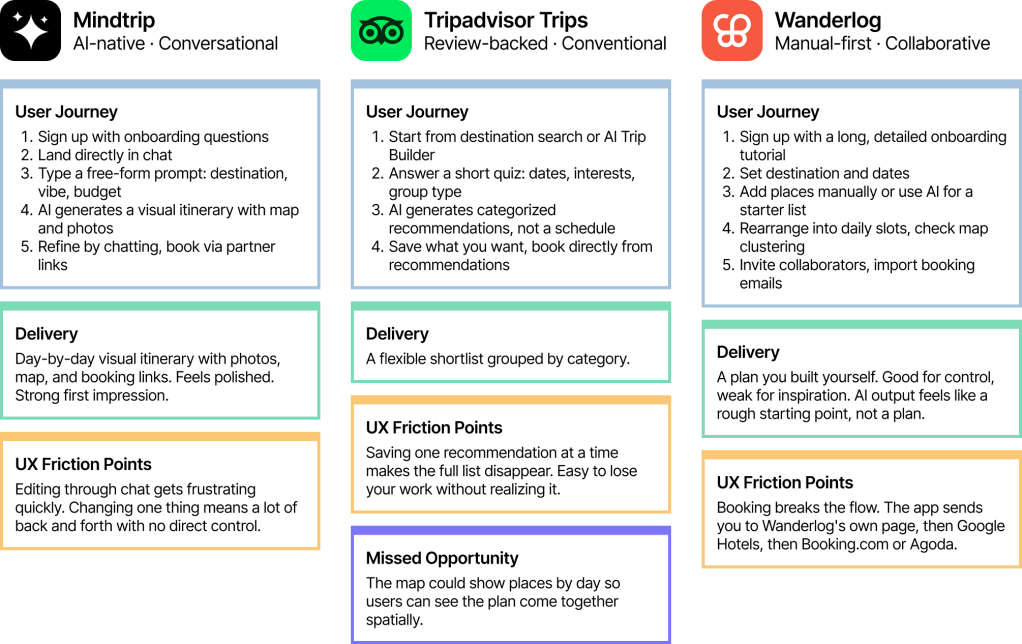
WHERE EXISTING TOOLS FALL SHORT
Understanding the space also meant looking at what competitors are already doing and where they stop short.
UNLOCKING UNMET MARKET NEEDS
The weaknesses in existing tools are not just flaws, they are opportunities. These are the spaces ItenarAI is designed to step into.
The Cold-Start Problem: Friction in Prompting
Wanderlog asks nothing. Tripadvisor asks too little. Mindtrip relies on how well users can write a prompt.
Opportunity:
A short, guided preference step that feels like a conversation, not a form.
Disconnect Between Financial Bounds and Itinerary Generation
No app connects budget to the itinerary itself. Users care about value/price.
Opportunity:
Show estimated daily cost inline and flag budget-friendly vs splurge options as you plan.
Cognitive Overload in Text-Heavy Interfaces
All three apps lean heavily on text. When everything looks the same, nothing stands out and users stop engaging.
Opportunity
Lead with visuals and short labels. Show more only when the user asks for it.
Rigid Static Outputs vs. Dynamic Real-World Variables
Mindtrip edits through chat are slow. Wanderlog requires manual rearranging. Tripadvisor shows the draft, and guide to user save it entirely.
Opportunity
Make the plan feel like a living document. Easy to swap, skip, or regenerate any part of it.
02
DECIDE
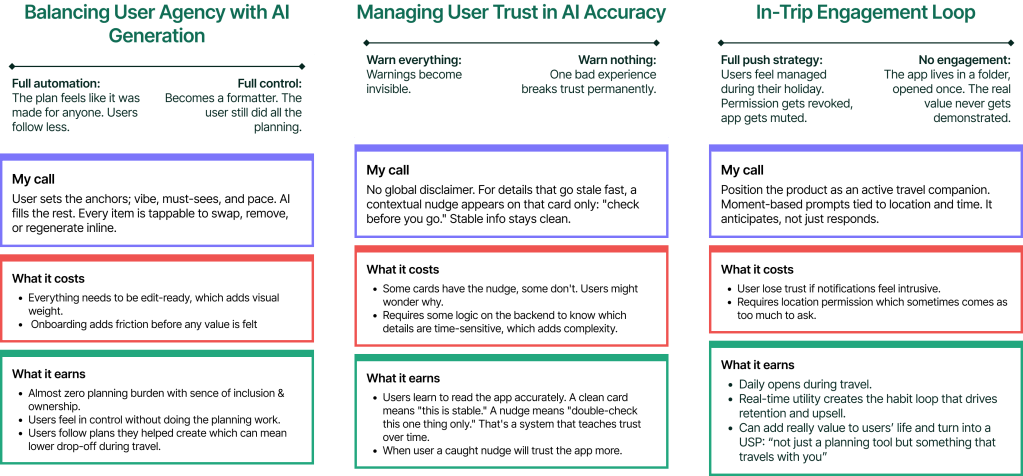
Every product decision has a cost. The goal is not to find the perfect answer but to know what you are giving up and why it is worth it.
For each core product decision in ItenarAI, I mapped the systemic trade-offs, identified what breaks at each end, and chose the position that fits the user and the business best.
03
HAPPY PATH
I mapped the full user journey from first open to trip complete. This covers the happy path for a first-time user across three phases: planning, reviewing, and traveling.
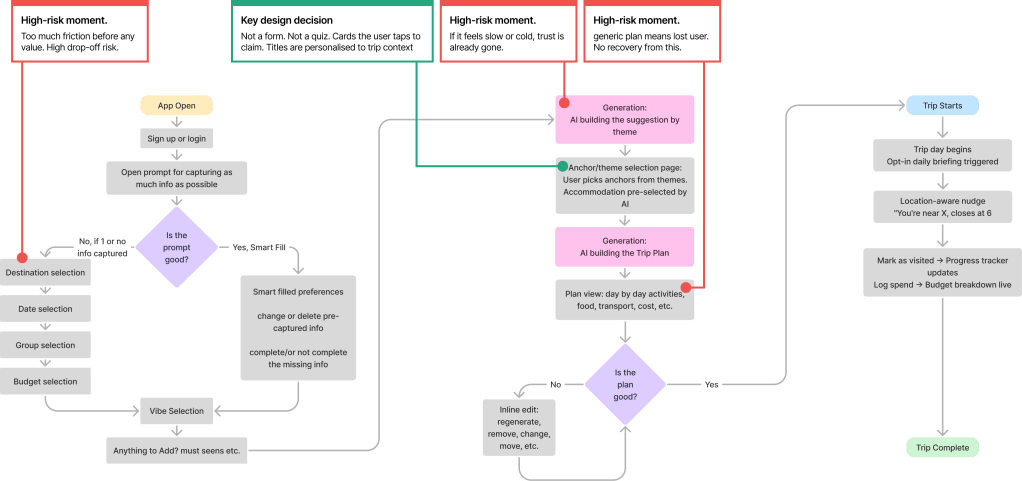
04
WIREFRAME
This stage was about exploring ideas and figuring out what works before committing to anything. Kept the focus on layout, hierarchy, and flow.
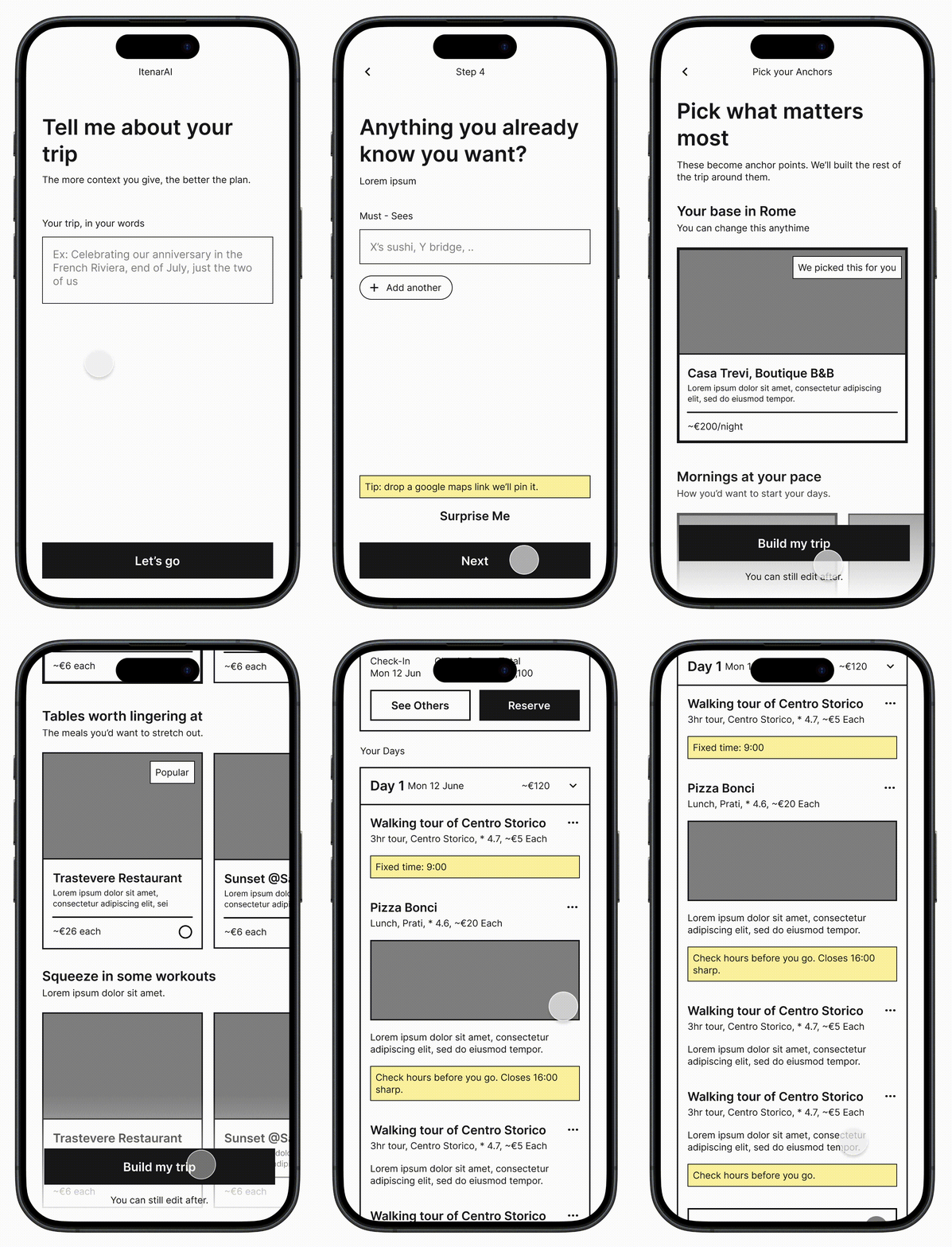
05
DESIGN
PROMPT FIRST ONBOARDING
The app reads what the user typed and fills in the details automatically. The user only confirms or adjusts what’s already there, no form to fill from scratch.
⟡ Less typing, faster to a plan. ⟡
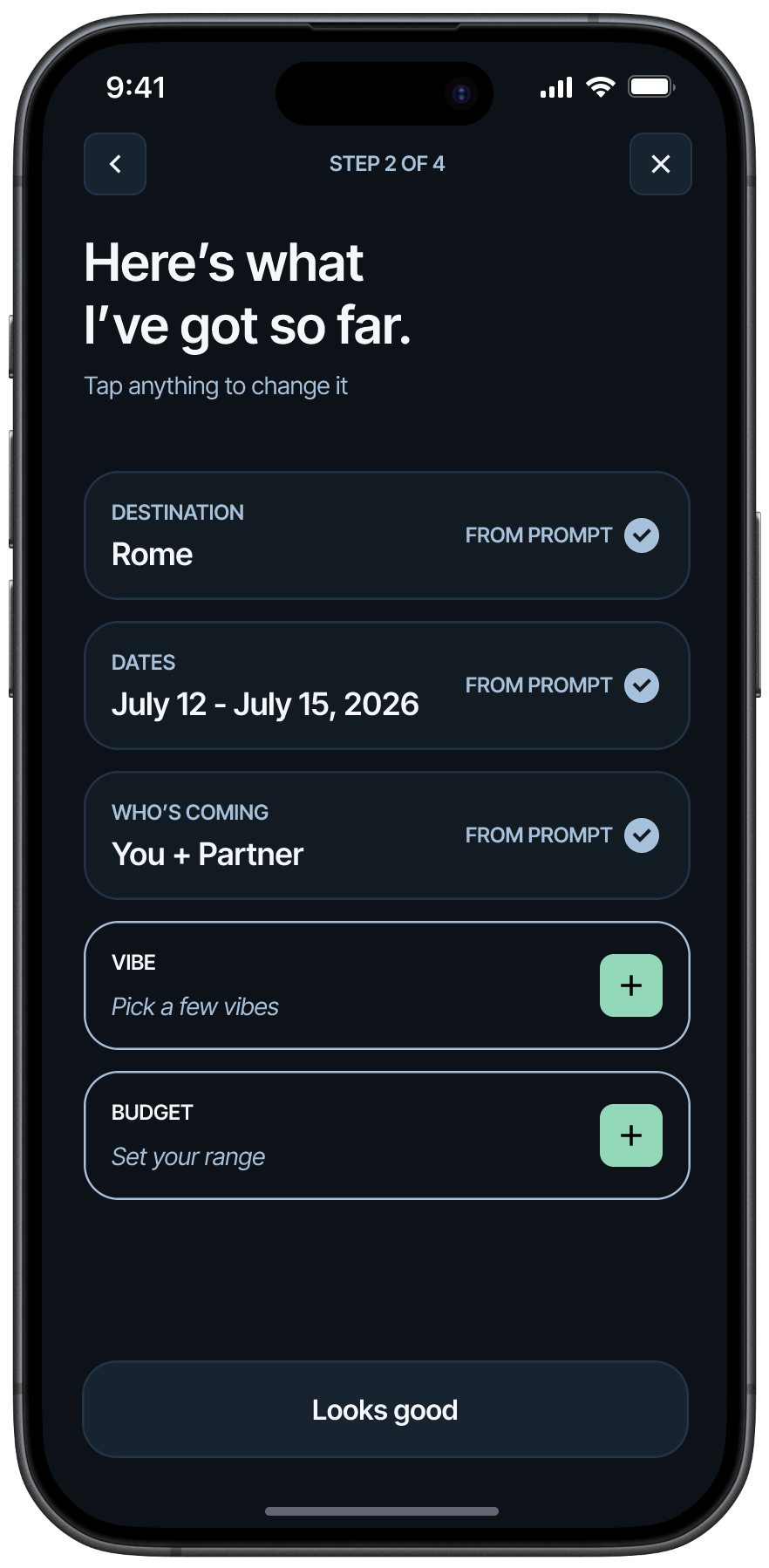
PLAN BUILT AROUND WHERE YOU SLEEP
Accommodation sits above the itinerary, not treated as just another item in the list. Everything else, activities, budget, timing, is organized around it because where you stay shapes how you move.
⟡ The plan reflects how people actually travel. ⟡
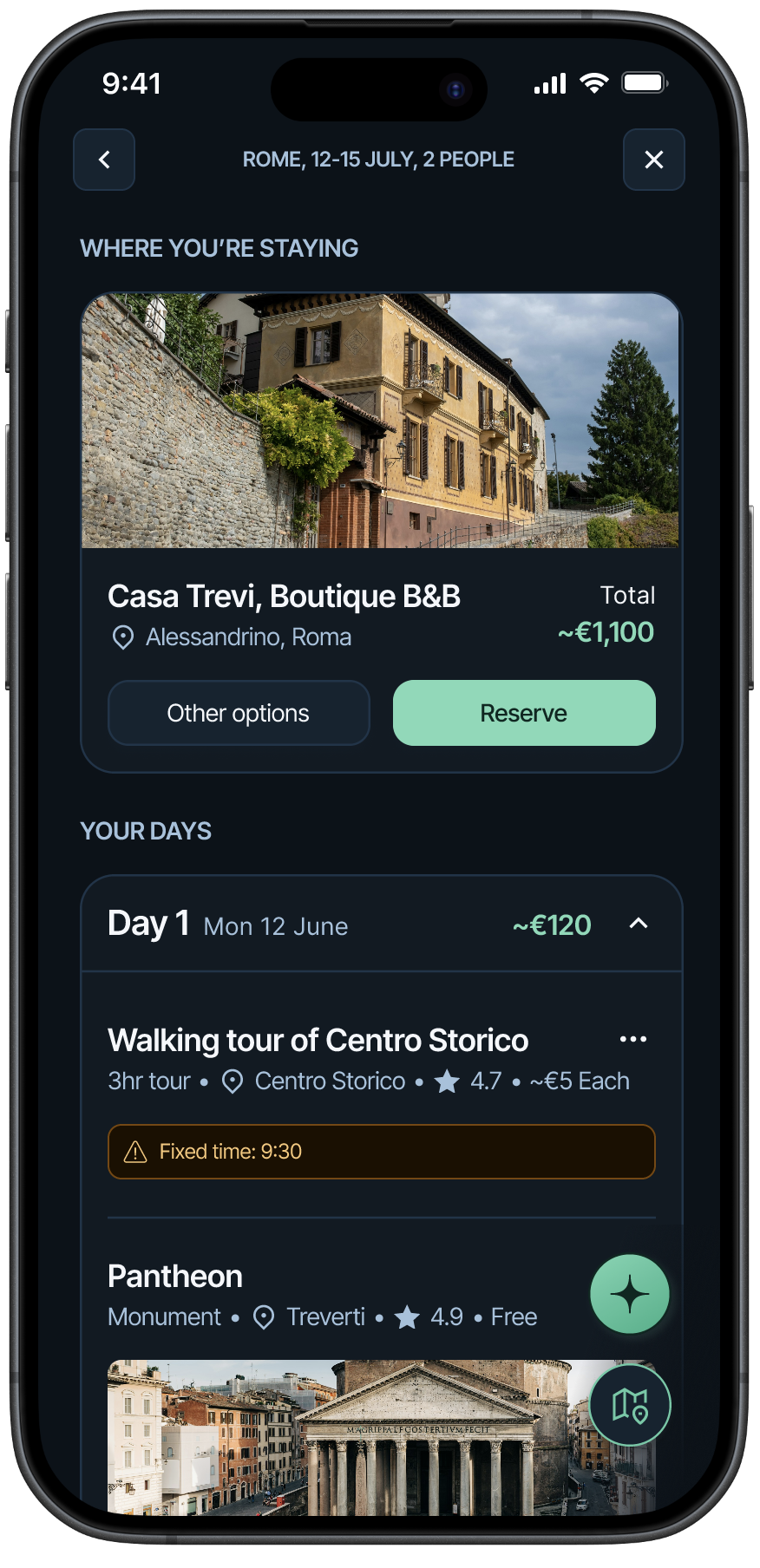
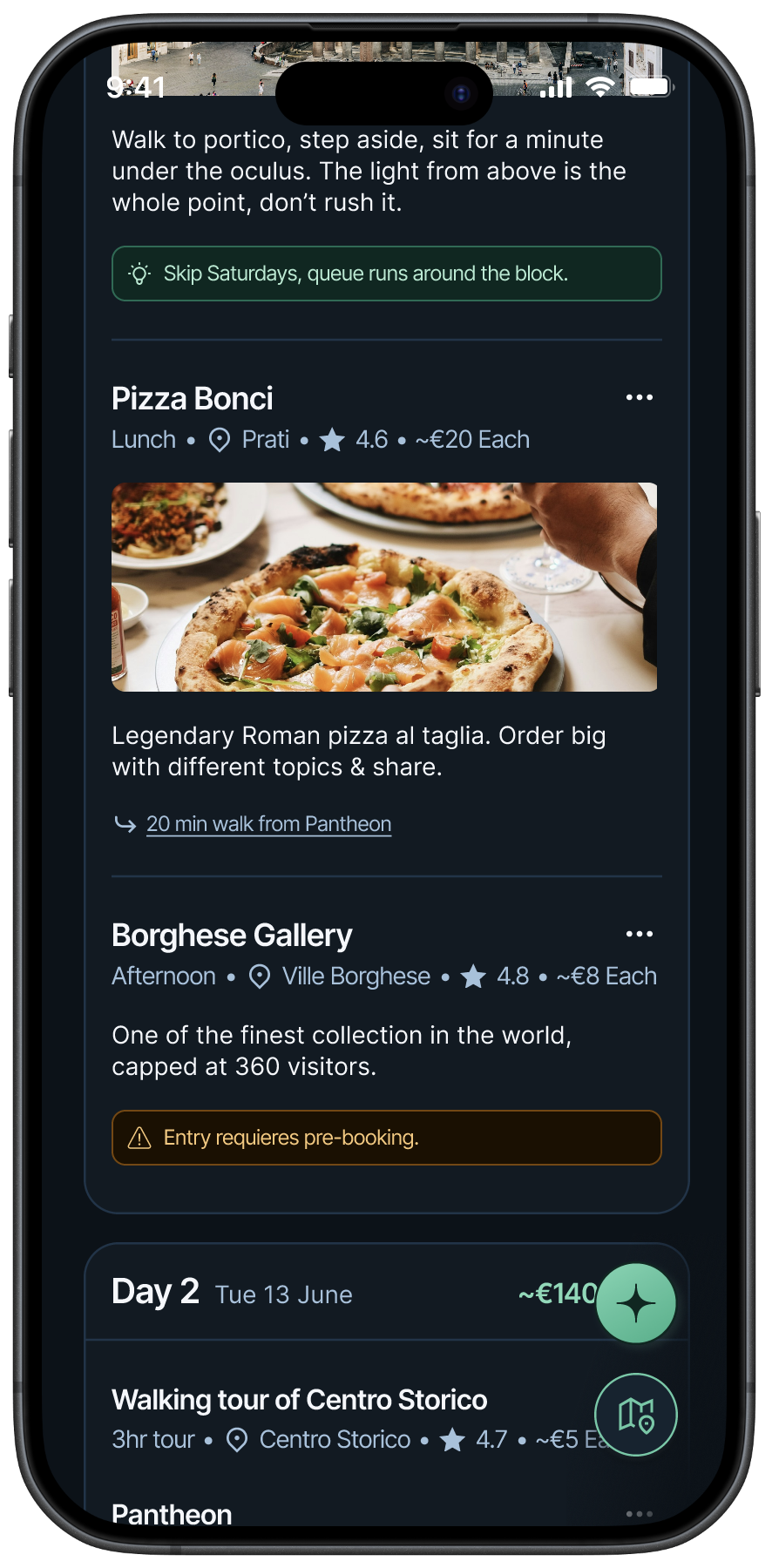
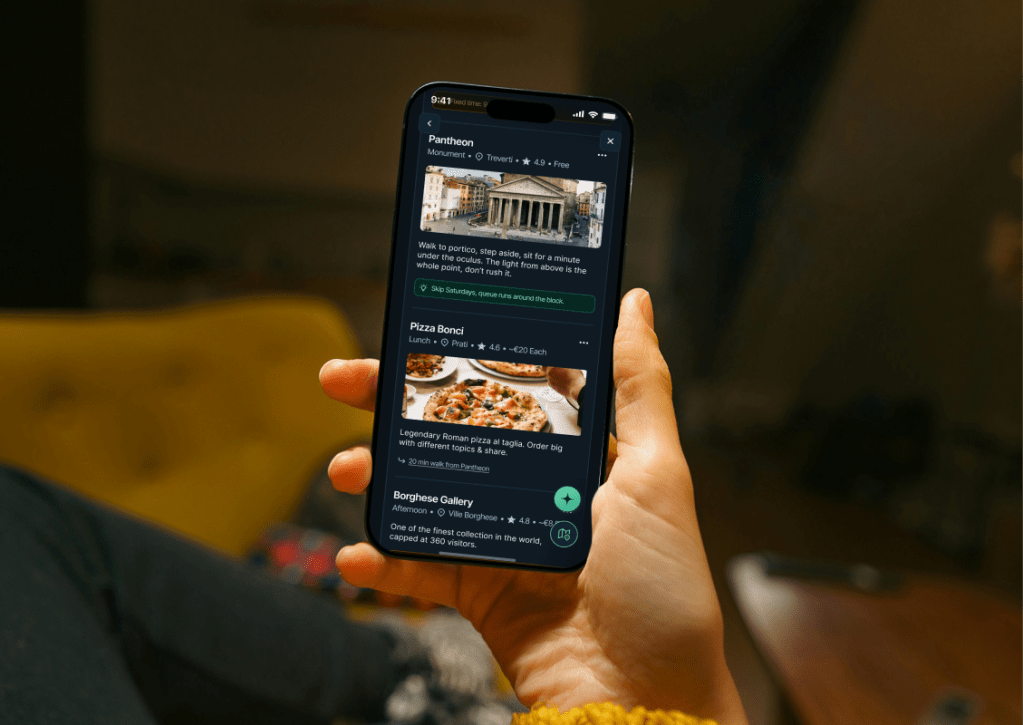
TIPS THAT FEEL LIKE A LOCAL TOLD YOU
Instead of generic AI disclaimers, each item surfaces a specific, practical tip based on what it is and when you are going: skip a busy day, pre-book a ticketed venue. Nothing obvious, nothing that applies to everything.
⟡ Useful context at the right moment, without the noise. ⟡